Learning Objectives
- Outline the overview of respiration in terms of energy level between substrate and product
- Outline how carbohydrates, fats and proteins can be used to make ATP
- Describe the structure and roles of ATP as the universal currency of energy
- Compare and contrast aerobic with anaerobic respiration in humans
What is cellular respiration?
Cellular respiration is a process that releases energy by breaking down nutrients, primarily carbohydrates in the form of glucose. The process starts from the cytoplasm of a cell, and continues in the mitochondria (an organelle). The final products of cellular respiration are CO2 and H2O whilst the by product is the energy in a form of ATP where the potential chemical energy from the glucose, is trapped in the molecule of ATP. Some potential energy from glucose is lost to the surrounding in the form heat.
If there is sufficient amount of oxygen in the cell, glucose will be used in cell respiration following these steps:

Are carbohydrates the only nutrient that can yield ATP?
Short answer is no. In general, the monosaccharides (glucose, fructose and galactose) can all be used in cellular respiration as the starting materials. However, in the event of prolonged exercise (such as running in a marathon), consuming low-card diet and fasting, the glucose level is very low and glycogen may run out. The body use the alternative sources of energy: fats and protein. Fats can undergo gluconeogenesis where they get converted to glucose. On the other hands, both fats (the fatty acid chains are chopped into 2C molecules) and proteins (deaminated amino acids which is after their -NH2 group have been removed) can enter the cellular respiration pathway from the Krebs cycle.
What is an ATP?
In the previous topic, we were introduced with nucleotides. ATP is just another nucleotide but instead of becoming a long chain polymer and carrying genetic information like DNA, it exists as it is – a single unit. ATP stands for adenosine triphosphate: a nucleotide with three phosphate groups attached to it. The structure looks like this:
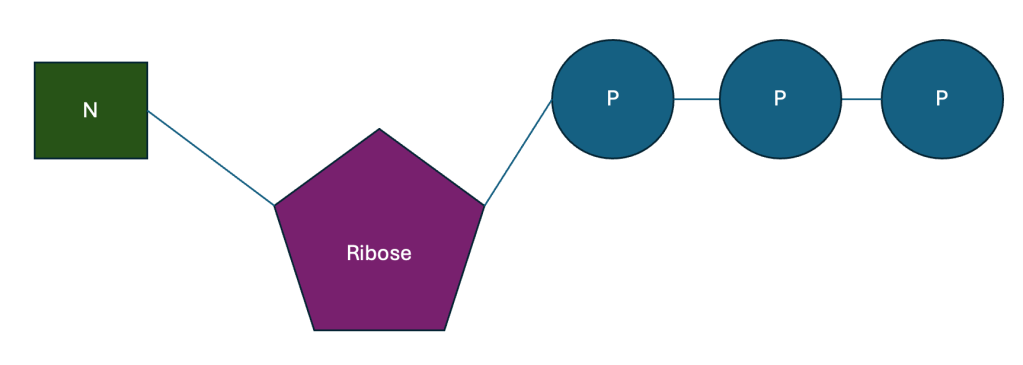
In general, ATP is an ideal currency of energy as it can move readily between cells and throughout organisms, primarily through facilitated diffusion. It is a highly reactive molecule capable of participating in numerous stages of cellular respiration and a wide range of metabolic reactions. ATP is an immediate source of energy that can release relatively small amounts of energy, sufficient to drive individual cellular reactions and physiological processes. How does it release the energy? When the third phosphate group is removed, the chemical bond is broken down between second and the last phosphate group, releasing energy. This energy can be used for muscle contraction, cell repairs, transport and other processes in the body.
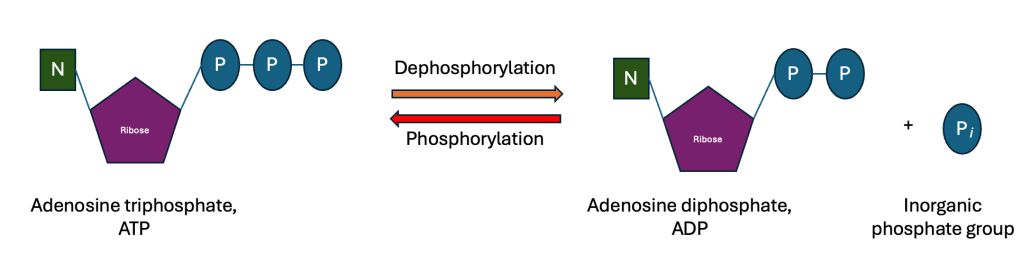
Gydrolysis of ATP can be written as:
ATP + H₂O → ADP + Pi
This reaction yields around 30 – 40 kJ/mol of energy. Most of this energy can be used and available to do work but some is still lost as heat to the surrounding. ATP provides a direct source of energy for numerous cellular processes, including:
- Movement of cellular components, such as the transport and separation of chromosomes during cell division.
- Active transport of molecules and ions across cell membranes by membrane pumps.
- Synthesis of macromolecules, including proteins, nucleic acids and other biomolecules, during anabolic processes.
- Cellular movement, enabling the movement of entire cells.
The dephosphorylation, typically a hydrolysis of ATP in the body, is a thermodynamically favourable reaction. This is because ADP has lower energy level and more more stable than ATP. That being said, during cellular respiration, energy obtained from breaking down glucose is used to phosphorylate ADP with Pi to make ATP.
What are the differences between aerobic and anaerobic respiration in humans?
Aerobic respiration refers to the normal condition where the demand of energy by muscle contraction can be met by the sufficient supply of oxygen. When this demand is too high and oxygen is not supplied to complete the full cellular respiration pathway, the cell will instead ferment the glucose to another product via a different metabolic pathway. This is called anaerobic respiration.
How does aerobic respiration look like?
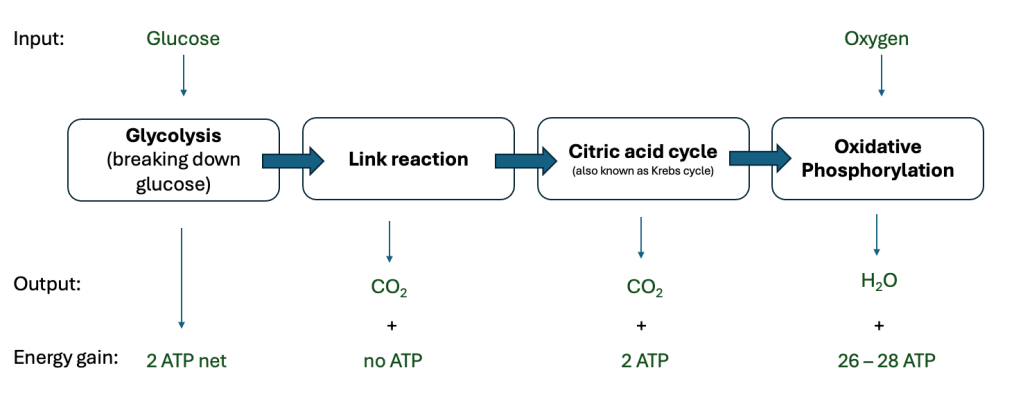
The overall equation of aerobic respiration can be written as:
C₆H₁₂O₆ + 6O₂ → 6CO₂ + 6H₂O + energy
In the absence of of oxygen, for instance during long vigorous muscle activity, the pathway is cut short. Glycolysis (the first step) still takes place but the product of glycolysis (known as pyruvate) is converted to lactic acid with no further production of ATP. This means that the anaerobic respiration yields only 2 ATP net.
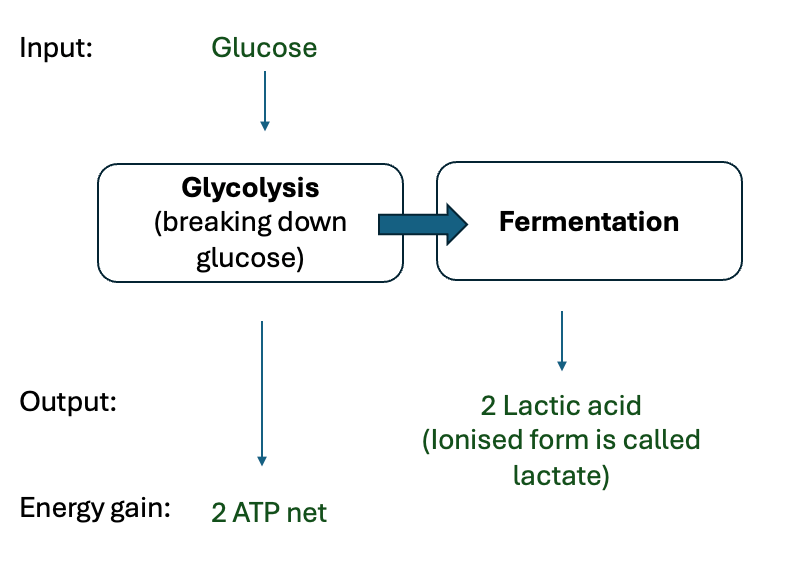
The equation for anaerobic respiration can be written as:
Glucose → 2 lactate + 2 ATP
Exercise
- Outline why ATP is an efficient energy currency molecule.
- Compare and contrast between aerobic and anaerobic respiration (use a table fr organisation)
- Draw a Venn diagram to show the similarities and differences between protein, ATP and carbohydrates in terms of the element present in the molecules.


Leave a Reply