Learning Objectives
- Outline how different factors can affect the rate of respiration
- Investigate how temperature effects the rate of photosynthesis of germinating peas using respirometer
How some factors affect rate of respiration?
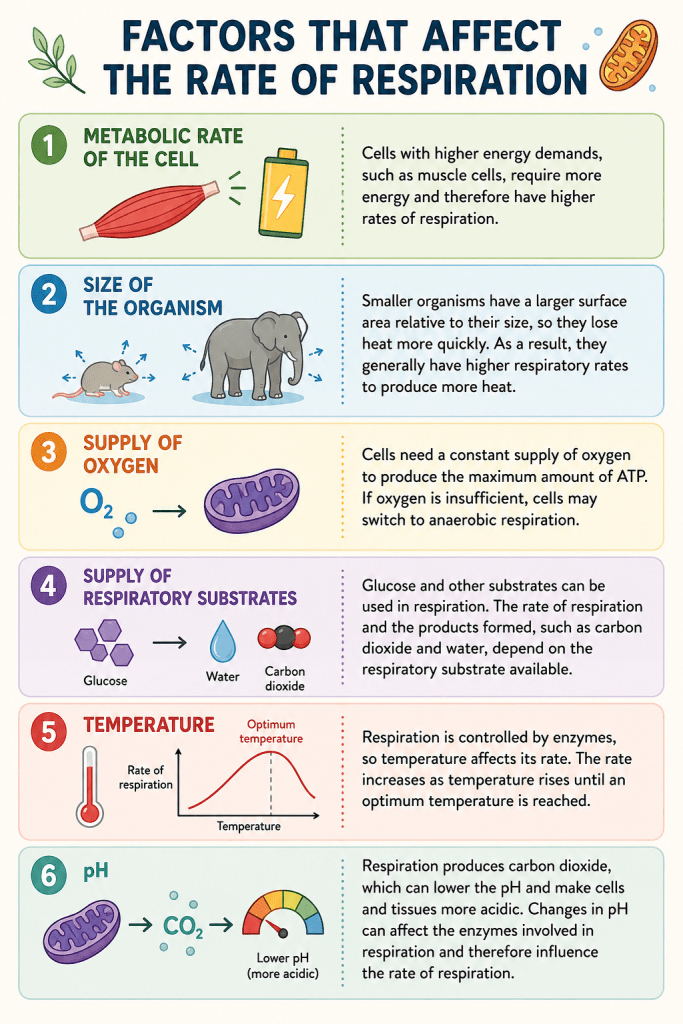
The rate of cellular respiration is influenced by several interrelated factors, including the metabolic requirements of cells, the size of the organism, oxygen availability, the supply of respiratory substrates, temperature, and pH. Cells with high metabolic demands, such as muscle cells, require substantial amounts of energy to support their activities and consequently exhibit higher rates of respiration. The size of an organism can also influence its respiratory rate. Smaller organisms have a greater surface area-to-volume ratio, which results in more rapid heat loss to the surrounding environment. Consequently, they generally maintain higher rates of respiration to generate sufficient metabolic heat.
The availability of oxygen is another important factor affecting respiration, as oxygen is required for aerobic respiration and the efficient production of ATP. Cells therefore require a continuous and adequate supply of oxygen to sustain a high rate of aerobic respiration. When oxygen availability becomes insufficient, cells may rely on anaerobic respiration, which produces less ATP. In addition, the availability of respiratory substrates, such as glucose, influences the rate of respiration. Different substrates can be utilized in respiratory pathways, and both the rate of respiration and the metabolic products produced, including carbon dioxide and water, may vary depending on the substrate available.
Temperature also has a significant effect on the rate of respiration because the process is regulated by enzymes. As temperature increases, enzyme activity generally increases, resulting in a higher rate of respiration until an optimum temperature is reached. Beyond this optimum, excessive temperatures may impair enzyme function and cause the respiratory rate to decline. Finally, pH influences respiration by affecting the activity of enzymes involved in the respiratory pathways. Carbon dioxide produced during respiration can contribute to a decrease in pH, increasing the acidity of cells and tissues. Changes in pH can alter enzyme activity and, consequently, affect the overall rate of cellular respiration.
What is a respirometer?
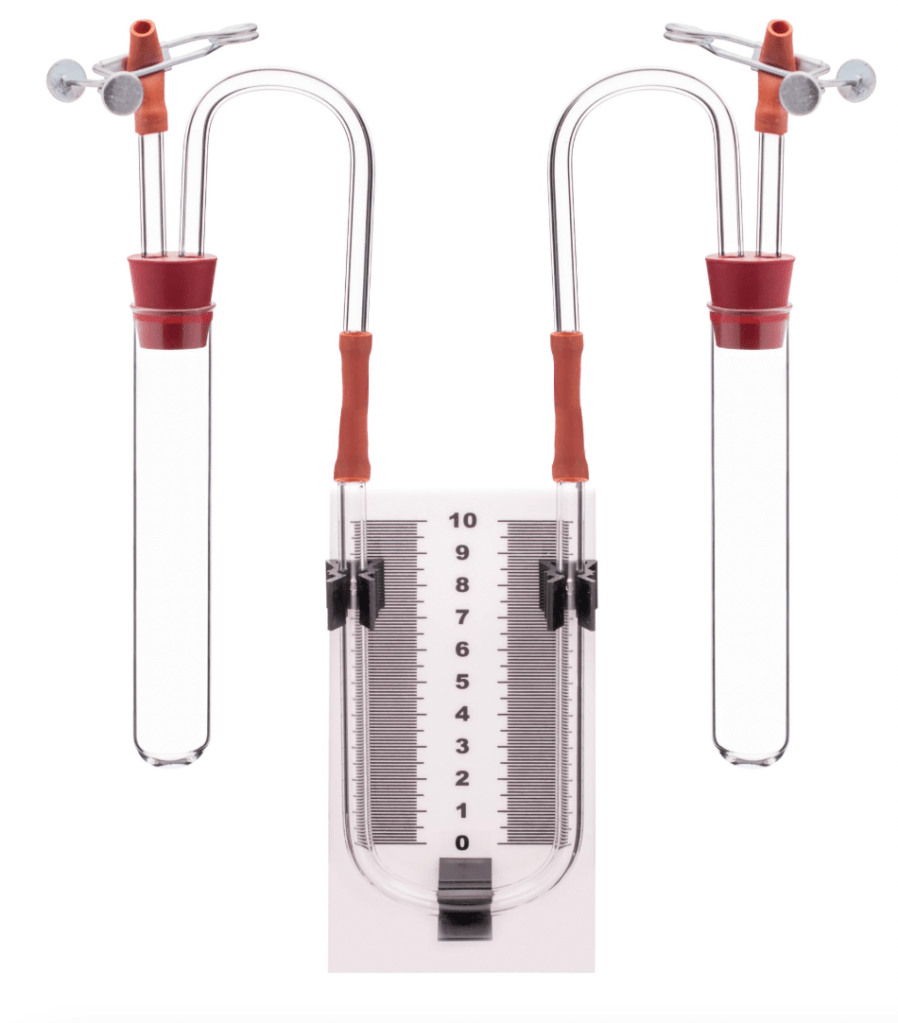
Respirometer is an experiment setup to measure the rate of respiration. This rate is measured by the rate of oxygen uptake. In other words, how much oxygen is consumed by respiration over time. To measure, a manometer is used to detect change in the pressure or volume of a gas.
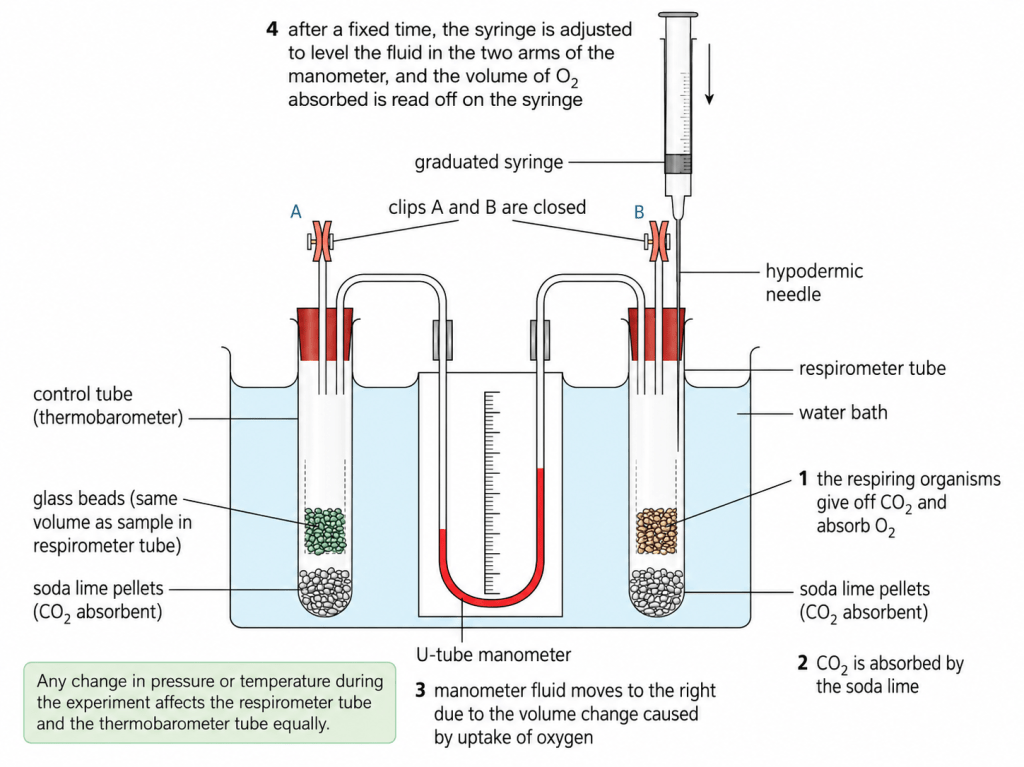
Based on the above diagram, the water marker (red liquid in the manometer) will move towards the side where there is respiration. In both test tubes, CO2 is absorbed by the soda lime pellets, reducing the air pressure inside each test tube. In addition, the right test tube undergoes respiration which consumes O2. This further reduces the air pressure in the test tube. As the result, the liquid moves towards the test tube on the right side of this respirometer.
How to calculate the rate of respiration?
The respirometer can be used to measure the rate of respiration by determining the rate of oxygen consumption, expressed in units such as mm³ min⁻¹. To determine the rate of respiration, the distance travelled by the fluid in the manometer is first measured over a fixed period, such as 10 minutes. The volume of oxygen absorbed during this period can then be calculated using the radius of the capillary tube, , and the distance travelled by the manometer fluid, . Since the capillary tube is cylindrical, the volume of oxygen consumed can be calculated using the formula , where represents the volume of oxygen absorbed. Finally, the average rate of oxygen consumption is determined by dividing the volume of oxygen consumed by the duration of the experiment in minutes. Thus, the calculated value represents the rate of respiration of the organisms under the experimental conditions.
Example of respirometer calculation
Question: Given that, after 10 minutes, the manometer fluid has moved a distance of 0.25 cm. The radius of the capillary tube is 1 mm. Calculate the rate of respiration.
Solution:
As given above, we are given the following information:
- t = 10 minutes
- d = 2.5 cm
- r = 1 mm
The volume of oxygen consumed can be calculated using the formula:
where:
- = volume of oxygen consumed (mm³) – we want to find this
- = radius of the capillary tube (mm)
- = distance moved by the manometer fluid (mm) where 2.5 cm = 25 mm
Substituting the values:
Therefore, the organisms consumed 78.5 mm³ of oxygen in 10 minutes.
The rate of oxygen consumption is:
Therefore, the rate of respiration is 7.85 mm³ min⁻¹.
[Investigation] How temperature affects the rate of respiration?
In this investigation, you will examine how temperature affects the rate of respiration in germinating peas using a respirometer.
Method
- Measure and calculate the average rate of respiration at room temperature using the respirometer and the method previously learned.
- Reset the apparatus by opening the clips to allow air to enter the respirometer. Use the syringe to return the manometer fluid to its starting position.
- Prepare water baths at the required temperatures, for example 30°C, 40°C, 50°C, and 60°C.
- Place the test tube containing the germinating peas into the 30°C water bath. Open the clips briefly to allow the apparatus to acclimatise to the new temperature. Close the clips to begin the measurement.
- Record the movement of the manometer fluid and calculate the rate of oxygen consumption. Use this value as the rate of respiration.
- Reset the apparatus and repeat the procedure at each of the remaining temperatures.
- Repeat each temperature condition where possible and calculate a mean value to improve the reliability of the results.
Data Collection Table
| Temperature (°C) | Trial 1 | Trial 2 | Trial 3 | Mean rate of respiration |
| RT | ||||
| 30 | ||||
| 40 | ||||
| 50 | ||||
| 60 |
Processing and Presenting Your Data
- Calculate the mean rate of respiration for each temperature.
- Identify any anomalous results and explain whether they should be included or excluded from your analysis.
- Plot a graph showing the relationship between temperature and rate of respiration.
- Place temperature (°C) on the x-axis and mean rate of respiration on the y-axis.
- Add an appropriate title and clearly label both axes, including their units.
Use your results from the investigation to assess the effect of temperature on the rate of respiration.
Conclusion
- Describe the relationship between temperature and the rate of respiration.
- At which temperature was the rate of respiration highest?
- What happened to the rate of respiration at temperatures above the optimum?
- Does your evidence support your original hypothesis? Explain your answer using specific results from your investigation.
- Explain your findings using your knowledge of enzyme activity and cellular respiration.
Evaluation
- Identify two limitations of the investigation.
- Explain how each limitation could have affected your results.
- Identify any possible sources of experimental error.
- Suggest two improvements that could make the investigation more reliable or accurate.
- Explain how your results compare with the expected scientific relationship between temperature and respiration.
- Suggest a follow-up investigation that could further explore the factors affecting the rate of respiration.
Extension Challenge
Predict: What would you expect to happen to the rate of respiration if the temperature were increased beyond 60°C? Explain your prediction in terms of enzyme activity.
Exercise
Question 1
A student wants to investigate whether temperature affects the rate of respiration in germinating seeds.
Identify:
- The independent variable.
- The dependent variable.
- Two variables that should be controlled.
- Why should a control respirometer be included?
- Why is soda lime used in the respirometer?
- Why should the experiment be repeated several times?
Question 2
A student investigates the effect of temperature on the respiration rate of insects.
| Temperature (°C) | Distance moved by manometer fluid (mm) |
| 10 | 8 |
| 20 | 15 |
| 30 | 24 |
| 40 | 12 |
If the capillary radius is 1.0 mm, and measurements are taken over 10 minutes,
- Calculate the volume of oxygen consumed at 20°C.
- Calculate the rate of oxygen consumption at 20°C.
- Calculate the rate of oxygen consumption at 30°C.
- At which temperature was the respiration rate highest?
- Explain why the respiration rate decreased at 40°C.
Question 3
A student records a manometer movement of 45 mm in 12 minutes using a capillary tube with a radius of 0.75 mm.
Calculate:
- The volume of oxygen consumed.
- The rate of oxygen consumption in mm³ min⁻¹.
- Explain what the calculated rate represents biologically.
Answers
Subscribe to get access
Read more of this content when you subscribe today.


Leave a Reply