Learning Objectives
- Outline respiration as a redox reaction
- Outline the roles of coenzyme NAD in respiration as a redox reaction
- Outline that Krebs cycle has four oxidation and two decarboxylation
- Explain the roles of oxygen as the terminal electron acceptor in aerobic respiration
- Outline how the absence of oxygen causes anaerobic respiration in terms of the NADH
- Outline the reasons why lipids yield more energy than carbohydrate
What are the roles coenzymes NAD and FAD?
NAD stands for nicotinamide adenine dinucleotide is a primary hydrogen carrier in cellular respiration. It is a coenzyme found in all living cells and is essential for converting food into usable energy. The more accurate way of writing it is by adding a plus sign to show that it is ready for a reduction reaction whilst it itself an oxidising agent. Here is the redox reaction between NAD⁺ and NADH :
- Reduction (→): NAD⁺ gains 2 electrons and 1 proton → NADH
- Oxidation (←): NADH loses 2 electrons and 1 proton → NAD⁺
In many biochemical reactions, you’ll also see the equivalent convention:
FAD (flavin adenine dinucleotide FAD) is a coenzyme that also acts as a hydrogen carrier during cellular respiration. FAD is the oxidised form that accepts two hydrogen atoms to become FADH₂.
You might wonder, what reduces these coenzymes?
This is when we go back to the cellular respiration equation itself. Take a look at this simplification of respiration as a redox reaction.
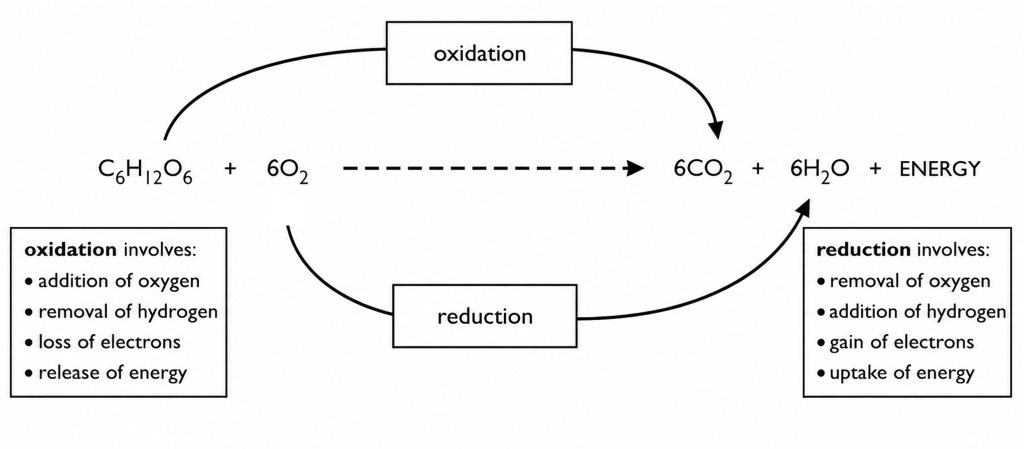
Generally, you could say that glucose is oxidised where the hydrogen is lost whilst oxygen is reduced by gaining hydrogen. A chemistry student might also say that the oxygen is the oxidising agent that that oxidises the glucose. This is idea is almost correct but lacks accuracy. It comes down to our coenzymes NAD and FAD. When they get reduced, it means that the carbon containing molecules (from food such as glucose in this example) is oxidised. There several steps where glucose is oxidised. You can count them! At the end, during the oxidative phosphorylation, the NADH and FADH2 (they are sometimes called “reduced NAD” and “reduced FAD”) are oxidised. Which means, something must have taken the electrons from them. That something is oxygen. The whole respiration metabolic pathway is a series of redox reaction.
What happens when NAD and FAD get reduced?
Let’s take glycolysis when G3P turns into 1,3-BPG, NAD is reduced. It is shown as below:
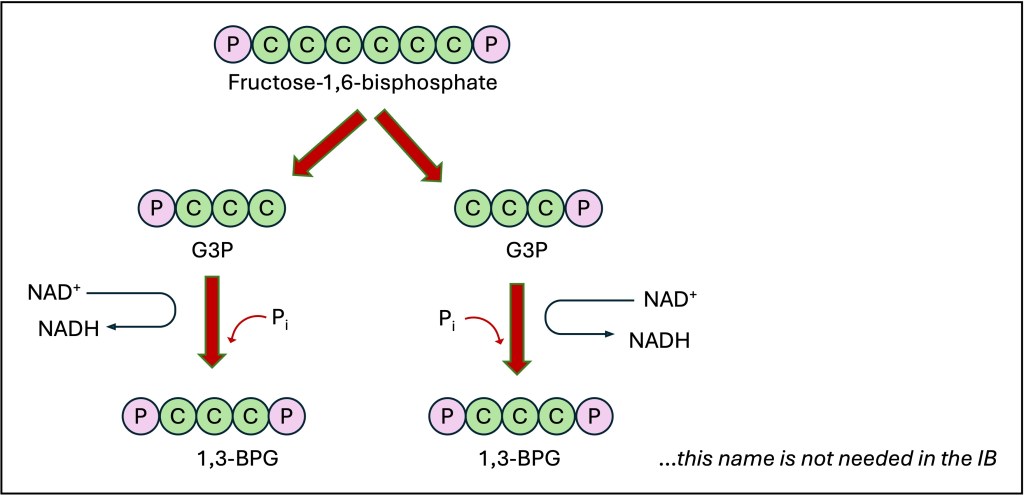
The NAD receives hydrogen from the sugar molecule. To be more accurate, NAD+ actually receives hydride (a hydrogen atom with an extra electron giving a total of 2 electrons). This is the reason why the reduction is sometimes written as follow:
NAD⁺ + 2e– + H+ → NADH + H⁺ …remember that hydrides has 2e–
As NAD is reduced, it helps the electron donor to get oxidised. Which means the sugar molecule is oxidised by losing hydrogen and/or donating electrons. At the end of respiration, NADH and FADH2 release or donate their high energy electrons during ETC to actively pump H+ from the mitochondrial matrix to the intermembrane space.
Summary of redox steps in cellular respiration
| Stage | What happens to the sugar/carbon molecule? | NAD⁺ reduced to NADH | FAD reduced to FADH₂ |
|---|---|---|---|
| Glycolysis | Glucose is oxidised as it is converted into 2 pyruvate | 2 NADH | Does not take place |
| Link reaction | Pyruvate is oxidised to acetyl-CoA | 2 NADH | Does not take place |
| Krebs cycle | Actual steps are not required by the IB. Each cycle has 4 oxidations where 3 by NAD reduction and 1 by FAD reduction | Total of 6 NADH per glucose molecule | Total of 2 FADH₂ per glucose molecule |
| Electron transport chain | NADH and FADH₂ are oxidised back to NAD⁺ and FAD | NADH is oxidised | FADH₂ is oxidised |
In the last step where oxygen becomes the terminal electron acceptor, the energy is very low that the product, which is water, is stable. In this last step, oxygen is reduced as they receive the electrons. Furthermore, they also take hydrogen to form water.
Is decarboxylation the same as redox?
No! decarboxylation simply means losing carbon. In this case, sugar molecule losses its carbon in the form CO2. Take a look at this decarboxylation summary
| Stage | Molecule undergoing decarboxylation | What is removed? | CO₂ produced per glucose |
|---|---|---|---|
| Glycolysis | None | No decarboxylation | 0 |
| Link reaction | 2 pyruvate | Each loses 1 CO₂ | 2 CO₂ |
| Krebs cycle | 2 acetyl-CoA (via their citrate-derived intermediates) | Two carboxyl groups are removed per acetyl group | 4 CO₂ |
| Electron transport chain | None | No decarboxylation | 0 |
| TOTAL | 6 CO₂ per glucose molecule |
The redox in anaerobic respiration
Why lactate is produced in our cells?
We know that NAD is reduced during glycolysis without the use of oxygen. To maintain balance in our cell, NADH must be reodixised to become NAD. However, if the oxygen is absent, there won’t be any electron acceptor in the ETC. Therefore in the event of oxygen absence and there is a continued production of pyruvate, the NADH donates it hydrogen back to pyruvate to produce lactate and NAD. This equation shows the process:
Pyruvate + NADH + H⁺ → Lactate + NAD⁺
The lactic acid fermentation (the anaerobic respiration in human or animal cells) is essential to allow pyruvate production to continue. If NADH is not oxidised, the cytoplasm can run out of NAD+ to oxidise glucose. Which means, the production of ATP (although in small amount by glycolysis) will stop.
Can the lactate be used as energy?
No as it is. Anaerobic respiration is a wasteful process. When oxygen is supplied again, lactate will be transported from muscle cells to the liver to be converted back to pyruvate. This can then re-enter the aerobic pathway.
Is brewing (alcoholic fermentation) an anaerobic respiration?
Yes! This is not done by animals cells. Yeast is the easiest example that does alcoholic fermentation. Unlike lactic acid fermentation, alcoholic fermentation is not reversible. The alcohol stays as it is in the cell. This is because the pyruvate undergoes a decarboxylation to produce ethanal and later an ethanol. This 2 carbon molecule is not a form of fuel for cells. Although we can harvest and use this ethanol as biofuel. Although not reversible, alcoholic fermentation is very useful for us in food and beverages. The carbon dioxide produced is the reason why dough rises in baking
Lipids as fuel
If we compare 100g of lipids with 100g carbohydrates, it appears that we can yield more ATP from lipids. Triglycerides can be used in respiration when a process called beta oxidation produces acetyl coenzyme A. How is this possible and why are we don’t we rely solely on lipids as the source of energy?
How lipids give more energy than carbohydrates?
Let’s look at this ratio of C : H : O in lipids and carbohydrates:
| Carbohydrates | Lipids | |
|---|---|---|
| Typical C:H:O ratio | 1 : 2 : 1 | ~1 : 2 : 0.1 (roughly) |
| Example | Glucose: C₆H₁₂O₆ | Palmitic acid: C₁₆H₃₂O₂ |
| Relative oxygen and hydrogen | A lot O, less H Less C-H | Less O, a lot of H A lot of C-H |
Carbohydrates have a lot of oxygen already present in the molecule. Which means that they are already partially oxidised. Remember that during cellular respiration, the substrates (food molecules) need to be oxidised to reduce NADH and FADH2. In the case of lipids, there are many hydrogen atoms in the molecules. This is called “in their more reduced form”. The presence of more oxidisable carbon and hydrogen (the C-H) will ultimately produce a lot more NADH and FADH2 molecules. Compare mass to mass, lipids give twice the amount of ATP that carbohydrates produce.
Should human rely on lipids for energy source?
Due to the high number of hydrogen atoms, the oxidation of lipids produces a lot of water molecules. The is called metabolic water because it’s not drank. For humans where we can easily access water, using lipids on normal days for energy is not favourable. There will be lot of water in the body. As the result, most lipids will be used for other processes such as transport, hormones and storage. If someone is fasting, it means that there is low glucose level and possibly water intake. Lipid oxidation will be beneficial. Camel and other animals living in the deserts will also benefit from lipid oxidation.
Exercise
Exercise
- Does this statement describe Krebs cycle? “A 4-carbon citrate binds with acetyl-CoA to form a 6-carbon intermediate which later undergoes 3 oxidation to form 5-carbon intermediate.” Explain your answer.
- The diagram shows a reaction that occurs during aerobic cell respiration.
Which type of chemical change happens to malic acid? - Triglycerides can be used in respiration when a process called beta oxidation produces acetyl coenzyme A. State the stage of respiration in which acetyl coenzyme A is used.
- Explain the reason that more energy is released from one gram of triglyceride than from one gram of glucose in respiration.


Leave a Reply