Learning Objectives
- Write the word equation of photosynthesis, outlining the raw materials, requirements, the main product and the by-product.
- Summarise the two stages of photosynthesis
- Outline how different factors influence the rate of photosynthesis
- Outline FACE with its importance
- Outline why cyanobacteria and algae can also perform photosynthesis
Overview of Photosynthesis
Photosynthesis is the process by which green plants and other photosynthetic organisms use light energy to make glucose from the inorganic substances carbon dioxide and water. This process takes place in the chloroplasts and requires chlorophyll and enzymes and releases oxygen as a waste product. This can be written as follow:
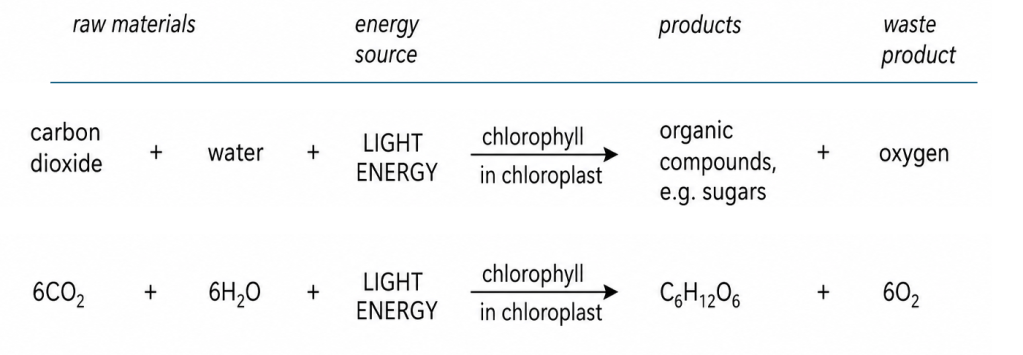
Photosynthesis is essential because green plants and other photosynthetic organisms capture energy from sunlight and use it to produce glucose. During this process, chlorophyll absorbs light energy and converts it into chemical energy, which is stored in molecules such as glucose and ATP. Photosynthesis therefore provides a major source of chemical energy needed to support life processes in ecosystems. The glucose produced may be temporarily stored as starch, but much of it is eventually used in metabolism to provide energy for cellular activities. Oxygen is released as a waste product of photosynthesis and is essential for the survival of many living organisms.
Photosynthesis also plays an important role in maintaining the composition of the atmosphere. For example, the amount of carbon dioxide removed from the atmosphere each day by plants and other photosynthetic organisms is approximately equal to the amount added through respiration and the burning of fossil fuels. Some of the oxygen produced by green plants is converted into ozone in the upper atmosphere by ultraviolet (UV) radiation from the Sun. This leads to the natural formation of the ozone layer in the stratosphere, which protects life on Earth by significantly reducing the amount of harmful UV radiation reaching the Earth’s surface. UV radiation can be very harmful to living organisms because it is absorbed by the organic bases of nucleic acids, such as DNA and RNA, causing changes or damage to these molecules.
How many steps are there in the photosynthesis?
In general, the are two main stages in photosynthesis. The first stage is the enzyme driven splitting of water and the second stage is the building up of glucose.
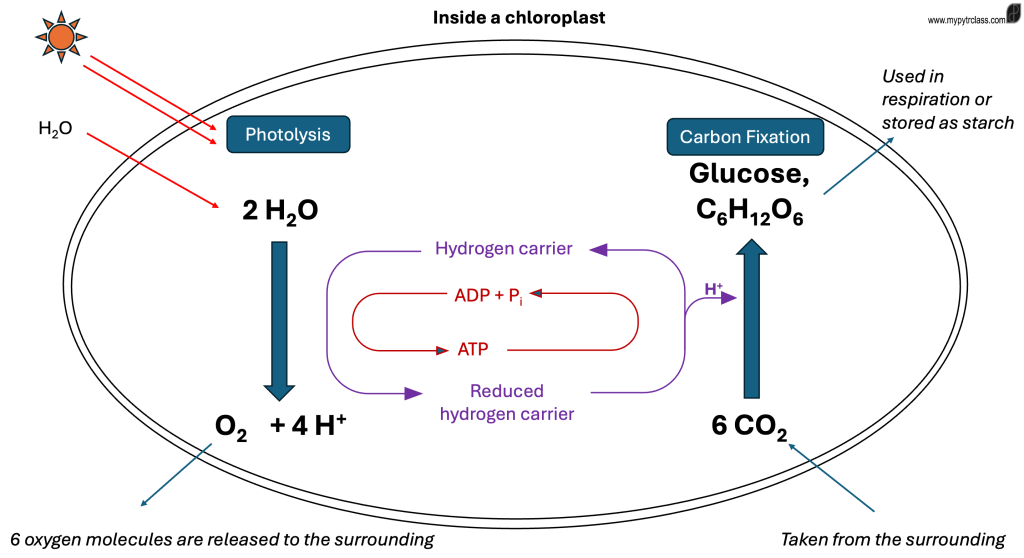
Stage 1: Photolysis
For each reaction, two water is used and split into 4H+ and O2 . Energy from the light is needed (hence this process is called photolysis) This step is the one producing oxygen which is then released to the atmosphere. The hydrogen is used to reduce hydrogen carrier. The hydrogen carrier will then pass this hydrogen to the second step to be added into the glucose molecule.
Stage 2: Building up glucose (carbon fixation)
CO2 (from the atmosphere) and hydrogen (from stage 1) are used and fixed to make glucose. Several enzymes and ATP are needed in this reaction.
Factors Affecting Photosynthesis
Experimental Setup
Factors can be investigated by different means. The following experimental setup is an example of how rate of photosynthesis can be investigated after a factor is manipulated.
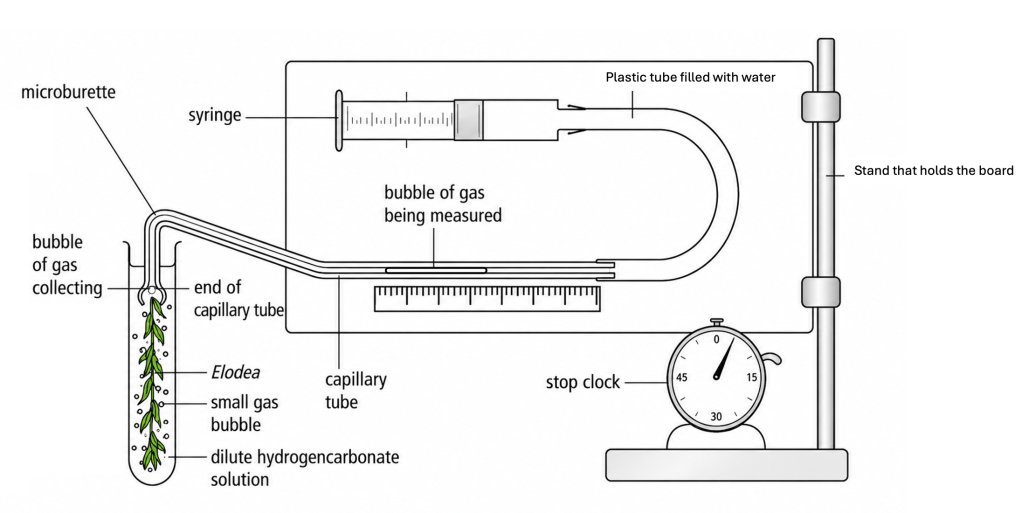
Using this universal experimental setup, different factors can be manipulated separately to study how each factor affects the rate of photosynthesis. The following table summarises the known factors and how they are manipulated
| Factor | How to manipulate | Responding variable |
| Temperature | Place the boiling tube containing the organism in a water bath preset with desired temperature. Do not heat the organism directly as it will kill it | Volume of oxygen is measured . Rate is calculated by diving the volume of oxygen produced with the time allowed for oxygen production |
| Carbon dioxide | Changing the concentration of hydrogencarbonate solution. This can be done by adding different amount of sodium hydrogen carbonate in the solution. When dissolved, this will make CO2 available for photosynthesis | |
| Light intensity | The light source (lamp etc) is systematically positioned at distances of 5, 10, 15, 20, and 25 cm from the experimental chamber. |
Experimental Analysis
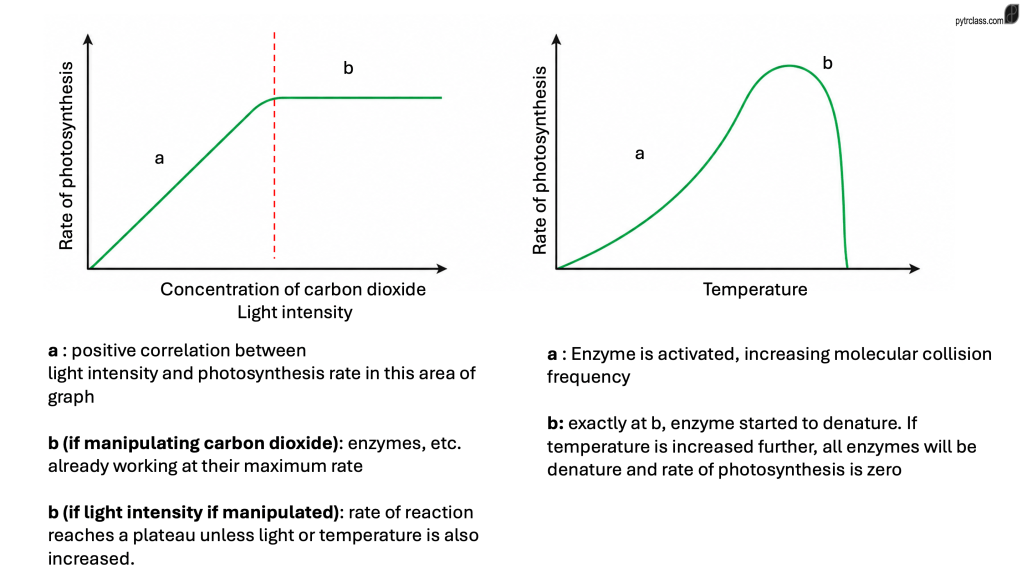
CO2 Enrichment Experiments
Carbon dioxide enrichment experiments are a means of predicting future rates of photosynthesis and plant growth. These experiments include:
- enclosed greenhouse experiments
- free-air carbon dioxide enrichment (FACE) experiments.
Enclosed greenhouse experiments manipulate variables that affect photosynthesis, such as sunlight, wavelength of light, and temperature, using greenhouses or polytunnels to control other environmental conditions. Because the plants used in these experiments need to be small enough to fit inside the greenhouses, and because the experimental conditions differ from those found in natural ecosystems, the results may not directly represent the changes that would occur in the natural environment.
In contrast, FACE experiments pump carbon dioxide into the air to increase its local concentration in natural ecosystems, including forests, grasslands, and agricultural fields. Unlike enclosed greenhouse experiments, FACE studies can investigate the effects of increased carbon dioxide concentrations on large producers, such as trees, under natural environmental conditions. However, other variables, such as rainfall and sunlight, cannot be controlled and therefore need to be carefully monitored.
Duke University’s FACE project in North Carolina, USA, began operating in 1996 and was the oldest forest FACE project. The project was used to investigate the response of a temperate coniferous forest to elevated atmospheric carbon dioxide concentrations. Tree growth and productivity were monitored under carbon dioxide concentrations of at least 550 parts per million, which was more than 1.25 times the atmospheric concentration at the time. As global atmospheric carbon dioxide levels continue to rise, predicting the effects of this increase on biological systems has become increasingly important.
What are cyanobacteria and algae?
In addition to plants, there are other organisms that can perform photosynthesis. They are cyanobacteria and algae. It is a common misunderstanding to say that only green algae can perform photosynthesis. Actually red algae can also perform photosynthesis and in fact, can have high rate of photosynthesis than green algae at certain depth of water. Plants, cyanobacteria and algae have pigments that give them their colours. Some of these pigments are photosynthetic pigments which absorb light energy for photolysis. Here is the summary of photosynthetic pigments:
| Group | Main photosynthetic pigments | Colour / characteristic |
| Plants | Chlorophyll a | Blue-green |
| Chlorophyll b | Yellow-green | |
| Carotenoids (e.g. carotene, xanthophylls) | Yellow, orange | |
| Cyanobacteria | Chlorophyll a | Blue-green |
| Phycocyanin | Blue | |
| Phycoerythrin | Red | |
| Carotenoids | Yellow/orange | |
| Green algae | Chlorophyll a and b | Green |
| Carotenoids | Yellow/orange | |
| Red algae | Chlorophyll a | Blue-green |
| Phycoerythrin | Red | |
| Phycocyanin | Blue | |
| Brown algae | Chlorophyll a and c | Greenish |
| Fucoxanthin | Brown/olive |
Since cyanobacteria and algae can perform photosynthesis, they also release oxygen as the by-product to the atmosphere. These are generally called phytoplankton, the main producer in the ocean.
Exercise
- Define photolysis
- Outline the role of hydrogen carrier in photosynthesis
- Compare and contrast two types of CO2 enrichment experiment
- Outline why excess amount of CO2 does not increase the rate of photosynthesis beyond the saturation point
- If an organism is allowed to photosynthesise for 20 minutes and produce 12 mL of oxygen, calculate the overall rate of photosynthesis


 MyPYTR Class
Leave a comment