Learning Objectives
- Explain the absorption of different wavelengths of light for photosynthesis
- Compare and contrast absorption and action spectra
- [Experimental skill] Separate and identify photosynthetic pigments
- Calculate retention factor (Rf)
Action Spectrum
Have you ever wondered why only the green parts of the plant are generalised to have the ability to perform photosynthesis? In the previous post, we know a few pigments are responsible for the colour of photosynthetic organisms. For plants, the common pigments known are chlorophyll a and b, and carotene (a type of carotenoids)
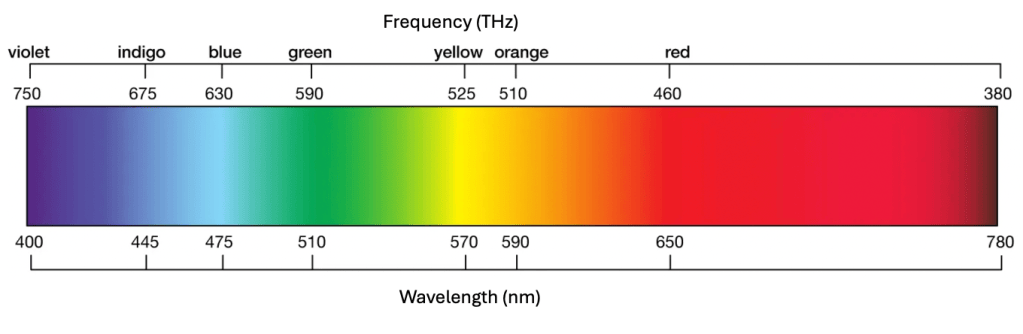
The above diagram shows the visible light spectrum. Among all the colours, we investigated which colour used the most in photosynthesis. Using colours might be less scientific as some colours occupy wider range of frequency and some are much narrower. Therefore, the investigation was done by manipulating the wavelength. The same setup was used using the microburette, as discussed in the previous post. The following graph is the result:
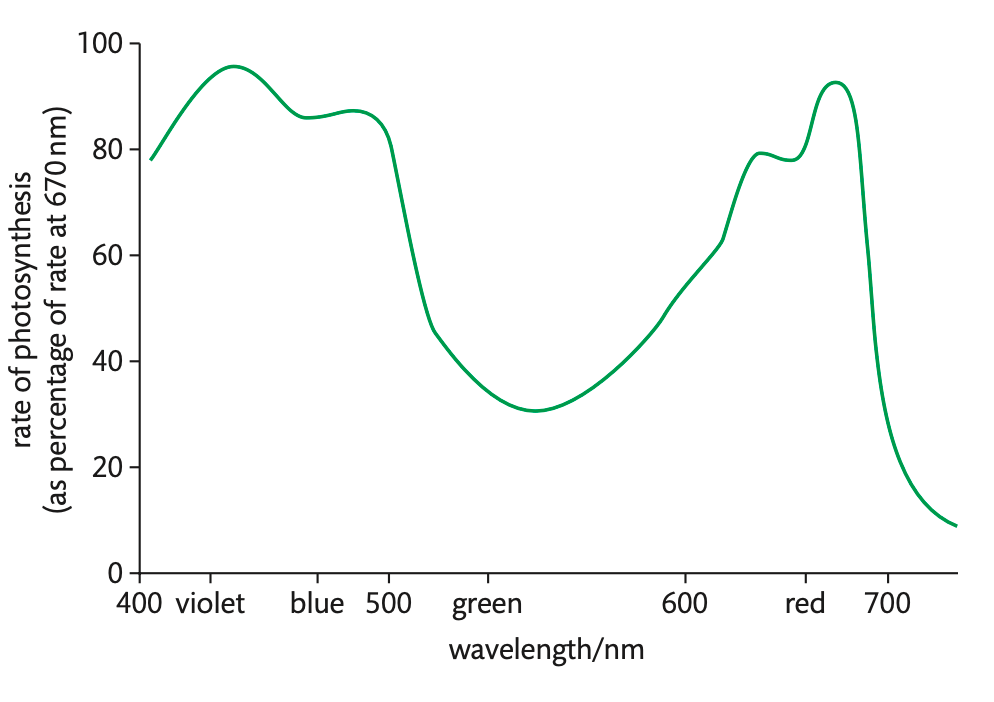
Based on the above graph, it shows that the rate of photosynthesis is the highest when given blue and red light, and lowest when given green light. It puzzled some people as why green, the colour of the plant, gives the lowest rate of photosynthesis. This is because green light is not absorb and rather reflected, giving the colour of the plant. Red and blue are absorbed the most by the pigments.
When a pigment molecule absorbs light, its electrons become excited to a higher energy level. Accessory pigments then transfer this absorbed energy to chlorophyll a, which initiates a series of reactions that ultimately result in the production of glucose. In this process, light energy is converted into chemical energy that can be stored and used by the organism.
[Lab] Separating and Identifying Photosynthetic Pigments
The next thing to understand is: what pigments are present in leaves, where photosynthesis takes place? To identify this, a chromatography method is used to separate dissolved and extracted pigments. The step by step of chromatography technique is shown below:
The usual chromatography lab activity uses spinach as the sample. The leaves contain several photosynthetic pigments. The main pigment is chlorophyll a, while chlorophyll b, carotenes and xanthophylls are accessory pigments. Different pigments absorb different wavelengths of visible light. The accessory pigments transfer some of this captured energy to chlorophyll a, which plays a central role in photosynthesis. Paper chromatography can be used to separate these pigments because they differ in their solubility in the chromatography solvent and their attraction to the chromatography paper.
There are two types of simple chromatography:
Paper chromatography
In paper chromatography, the stationary phase consists of a liquid held on the surface of the chromatography paper. The paper contains many pores that can adsorb water molecules and form hydrogen bonds with them, creating the stationary phase. The water can be displaced by other liquids to produce different stationary phases. As the solvent moves up the paper, pigments that are more soluble in the mobile solvent than in the water of the stationary phase move more rapidly and travel further up the paper. In contrast, pigments that are more soluble in the water of the stationary phase interact more strongly with the paper and therefore move more slowly and do not travel as far.
Thin-layer chromatography
Thin-layer chromatography (TLC) uses a stationary phase consisting of silica or alumina particles bonded to a thin layer of glass or plastic. TLC separates a mixture of pigments according to the strength of their interactions with the stationary phase and their solubility in the mobile phase, which is a liquid or mixture of liquids. The distribution of a pigment between the stationary and mobile phases is referred to as partitioning. Pigments with a greater affinity for the stationary phase interact more strongly with its surface and therefore move more slowly along the TLC plate, whereas pigments with a greater affinity for the mobile phase travel more rapidly.
Lab Activity: Separating Photosynthetic Pigments from Spinach or Kale
To download a chromatography lab worksheet, please login and click download below
Subscribe to get access
Read more of this content when you subscribe today.
Retention Factor, Rf
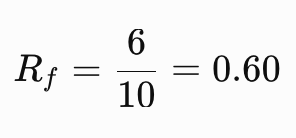
The retention factor, or Rf value, is calculated by dividing the distance travelled by a spot from its starting position by the distance travelled by the solvent front. The Rf value is characteristic of a particular solute when a specific solvent and stationary phase are used. Therefore, it can be used to help identify the components of a mixture by comparing their measured Rf value with those of known substances. The Rf value is calculated using this formula:

Example
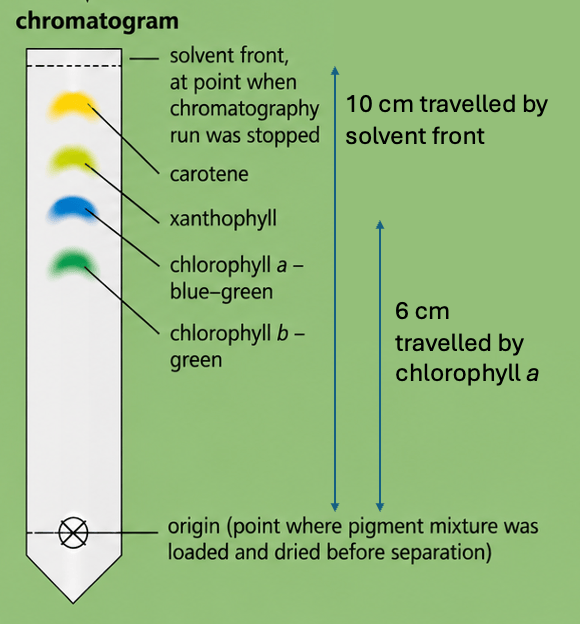
If a pigment travels 6 cm and the solvent travels 10 cm:
Absorption Spectra
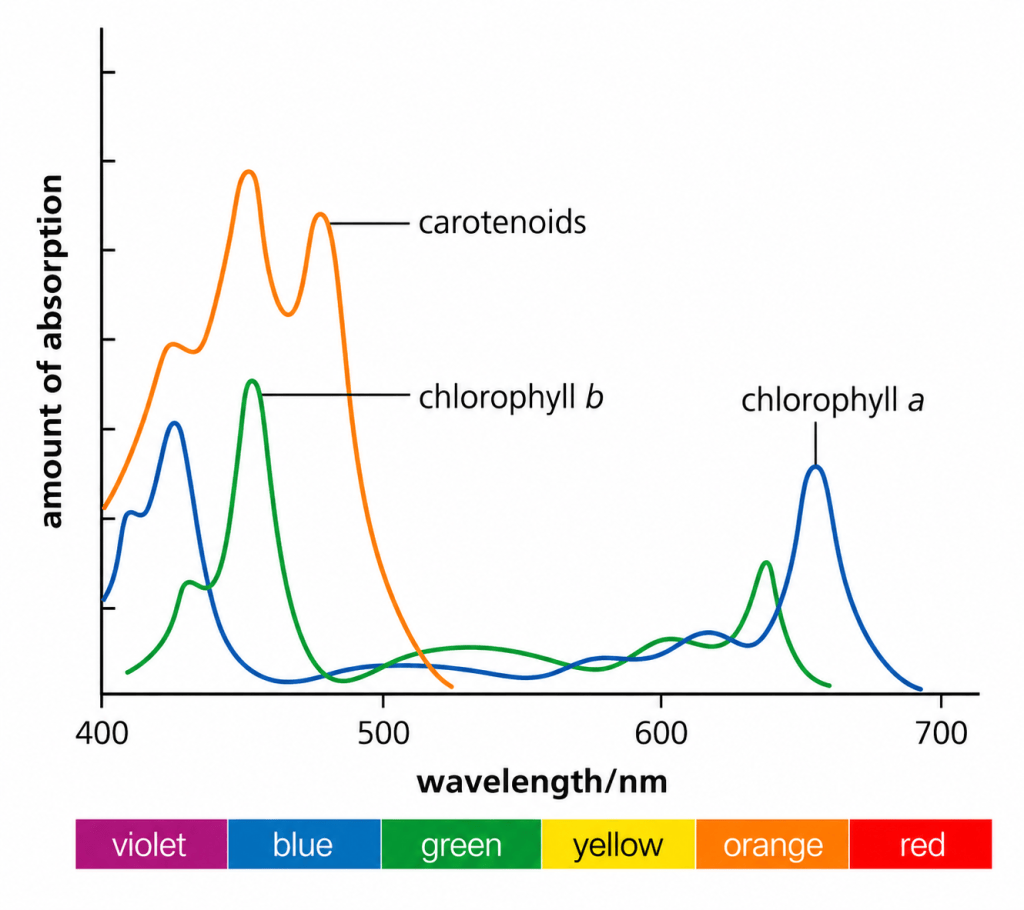
How that we have identified different photosynthetic pigments, we observed different colours for each pigment. This means that each of these pigments may absorb different wavelength of the visible light. A further investigation was done to identify the range of visible light wavelength absorbed by different photosynthetic pigments. This is called absorption spectra.
| Absorption spectrum | Action spectrum | |
| What is it? | Wavelengths of light absorbed by a pigment | Wavelengths of light that are most effective for photosynthesis |
| Example | Carotenoids absorbs mostly violet and blue whilst chlorophyll absorbs blue and red | Photosynthesis is most effective in blue and red light |
| Main use | Identifies which wavelengths a pigment absorbs | Shows which wavelengths actually drive the process |
| Graph y-axis | Absorbance | Rate of photosynthesis / biological activity |
Exercise
- Outline a role of accessory pigment during photosynthesis
- Explain why the four pigments moved at different rates through the chromatography paper.
- Based on the chromatogram, state which pigment is lighter and smaller
- Explain the difference between thin layer chromatography and paper chromatography.


Leave a Reply