Learning Objectives
- Understand the structures of chloroplast involved in photosynthesis.
- Explain the process of light-dependent reaction of photosynthesis
Where does photosynthesis take place?
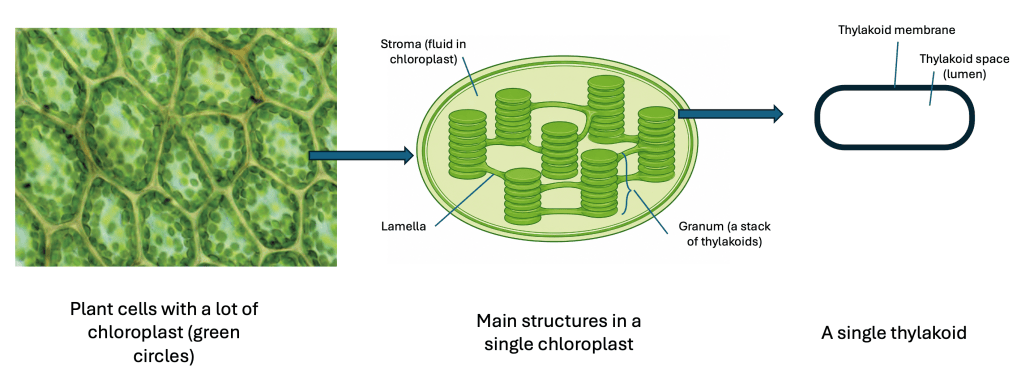
| Structure | What it is? | What is its role in photosynthesis? |
| Stroma | The fluid-filled region surrounding the thylakoids inside the chloroplast. It contains enzymes, DNA and ribosomes. | Site of the Calvin cycle. Enzymes in the stroma use ATP and reduced NADP (NADPH) from the light-dependent reactions to convert CO₂ into carbohydrates. |
| Lamellae (stroma lamellae) | Membrane structures that connect the stacks of thylakoids (grana). | Connect grana and provide membrane pathways containing components that help transfer electrons and energy between photosynthetic complexes. |
| Thylakoid | A flattened, membrane-bound sac containing chlorophyll and other photosynthetic pigments. | Site of the light-dependent reactions. Light energy drives electron transfer, producing ATP and reduced NADP (NADPH) and releasing oxygen from water. |
| Grana | Stacks of thylakoids connected by lamellae. | Provide a large surface area for light absorption and house many of the photosystems and electron carriers involved in the light-dependent reactions. |
Overview of Photosynthesis Reactions and Mediators
As we know, there are two stages in photosynthesis. In this lesson, we will start labelling them systematically:
- Stage 1: Light-dependent reactions. This is when photolysis takes place and oxygen is produced.
- Stage 2: Light-independent reactions. This is it’s generally called the carbon fixation reactions where glucose is made using carbon dioxides and hydrogen from water
If we focus on the two main parts involved in photosynthesis, we can summary the interactions and inter-dependence between the two stages of photosynthesis.
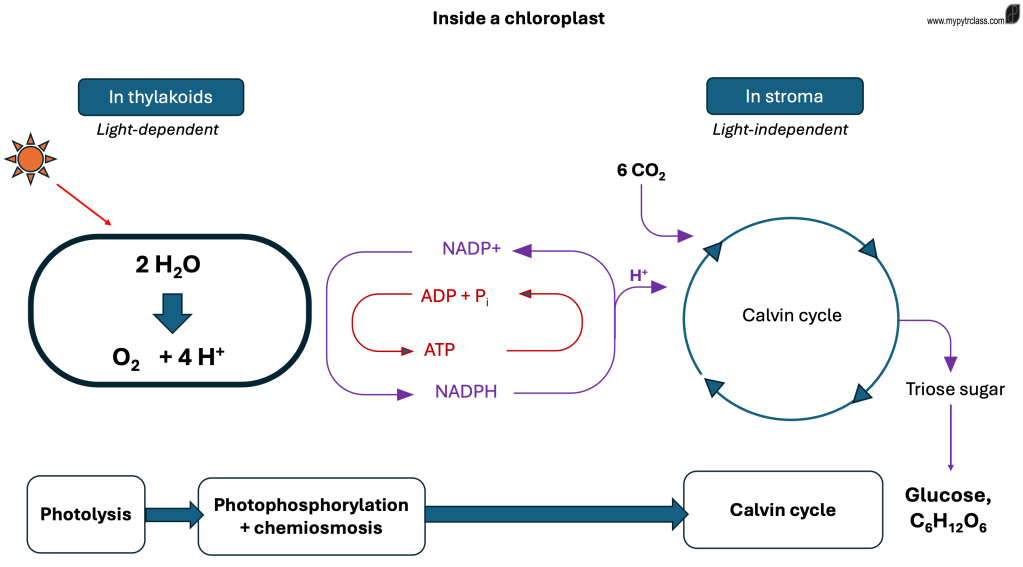
| Stage | What happens |
| Stage 1: Light-dependent Photolysis | Light energy splits water molecules into H⁺ ions, electrons, and O₂. This takes place in photosystem II (PS II) |
| Stage 1: Light-dependent Photophosphorylation / Chemiosmosis | Light energy is used to produce ATP from ADP and inorganic phosphate (Pi). The H⁺ gradient (produced by moving electrons from PS II to PS I) drives ATP synthase, which produces ATP. NADPH is produced when PS I passes 2 electrons to NADP+. Both ATP and NADPH are passed to stage 2 of photosynthesis |
| Stage 2: Light-independent Calvin cycle | Uses ATP, NADPH, and CO₂ to produce carbohydrates. |
What Happens During Light-Dependent Reaction?
The light-dependent reaction takes place in grana, specifically in thylakoids.
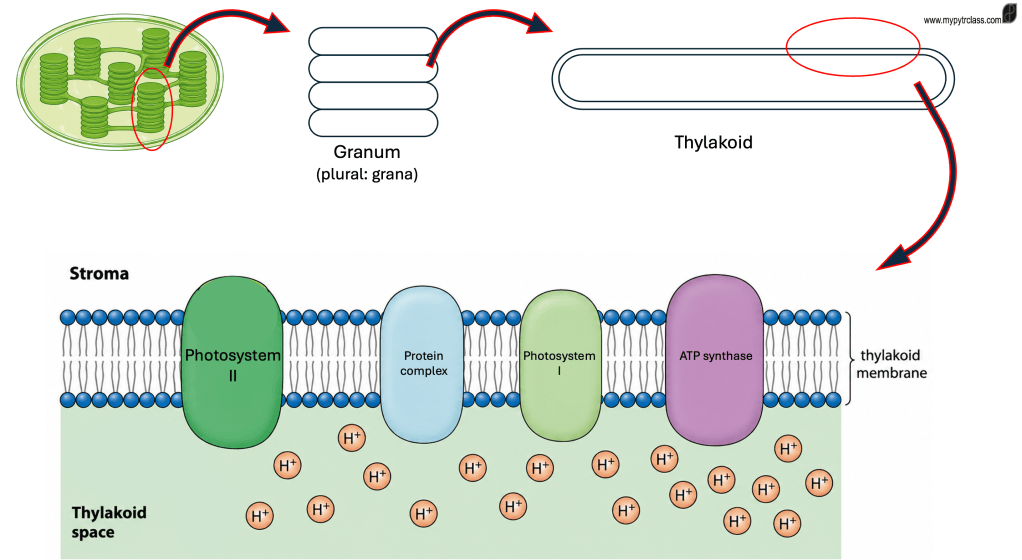
The following diagram shows the sequence of light-dependent reaction.
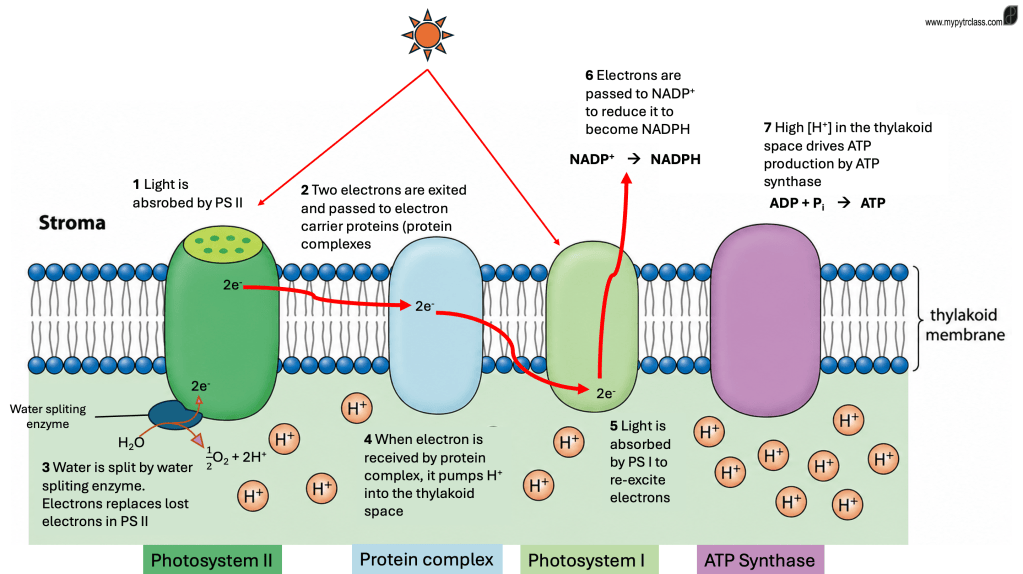
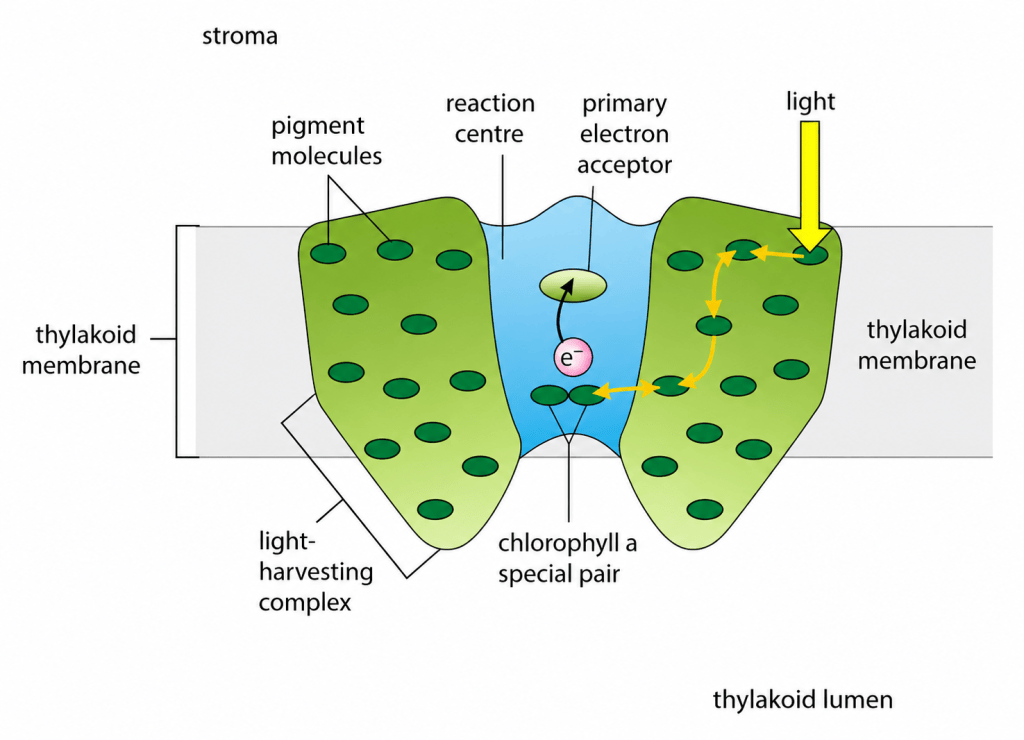
- A photon of light is absorbed by a pigment in Photosystem II and transferred between pigment molecules until it reaches a chlorophyll a molecule (P680) in the reaction centre. The energy from the photon excites an electron in the chlorophyll a molecule, raising it to a higher energy level.
- The excited electron is then transferred to the primary electron acceptor of the reaction centre.
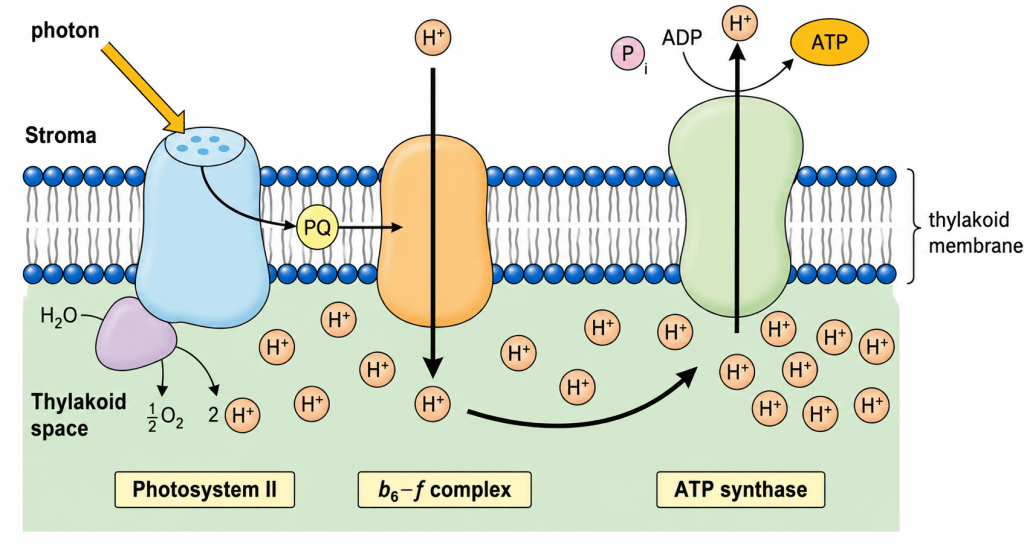
- Water is split by an enzyme into electrons, hydrogen ions (H⁺), and oxygen. This process, known as photolysis, is driven by light energy. The electrons produced replace those lost from the chlorophyll a molecules in the reaction centre.
- The excited electrons are transferred from the primary electron acceptor through an electron transport chain, losing energy as they pass between electron carriers. The first carrier is plastoquinone (structure not shown above), followed by a protein (cytochrome) complex.
- The energy released as electrons move through the electron transport chain is used to pump hydrogen ions across the membrane, creating a proton gradient. The movement of hydrogen ions down this gradient through ATP synthase drives chemiosmosis and provides the energy required to phosphorylate ADP to form ATP.
- A photon of light is absorbed by a pigment in Photosystem I and its energy is transferred through several accessory pigments until it reaches a chlorophyll a molecule (P700) in the reaction centre. The energy excites an electron to a higher energy level, and this electron is transferred to the primary electron acceptor. The electron lost from Photosystem II replaces the electron removed from the Photosystem I reaction centre.
- The high-energy electron is then transferred through a second electron transport chain, which includes the electron carrier ferredoxin (structure not shown in the diagram above).
- The enzyme NADP reductase catalyses the transfer of electrons from ferredoxin to the electron carrier NADP⁺. Two electrons, together with a hydrogen ion, are required to reduce NADP⁺ to NADPH.
- Chemiosmosis produces ATP when high proton concentration is achieved in the thylakoid space.
Does an electron get excited by a single chlorophyll?
Photosynthetic pigments work collectively to excite electrons in the reaction centre. A single pigment cannot excite an electron alone. Photosystems are molecular arrays of chlorophyll and accessory pigments with a special chlorophyll as the reaction centre from which an excited electron is emitted. The array of pigments can be illustrated as follow:
What drives ATP synthase to produce ATP?
Just like in cellular respiration, this process is done by chemiosmosis, where the light-dependent reaction in photosynthesis builds proton concentration gradient. This is achieved by the movement of electrons that pumps proton into the thylakoid space. High proton concentration in thylakoids eventually causes proton to move passively back into stroma via ATP synthase. Take a look at the following movement of protons
Exercise
- State the number of electrons are replaced in the reaction centre of Photosystem II by splitting water
- Outline the role of accessory pigments and their vicinity in the photosystem
- Write the reduction equation of NADP+
- Explain how high proton concentration can be achieved in the thylakoid space
- State two mediators needed in light-independent reaction from light-dependent reaction


 MyPYTR Class
Leave a comment