Learning Objectives
- Explain the process of light-independent reaction of photosynthesis
- Compare and contrast between cyclic and non-cyclic photophosphorylation
- Outline how the product of Calvin cycle is used to produce carbohydrates, amino acids and lipids
- Outline the interdependence of light-dependent and light-independent reactions
What Happens During Light-Independent Reaction?
In the previous post, we talked about how light-dependent reaction converts light energy to chemical energy (stored in ATP and NADPH). The next step of photosynthesis is light-independent reaction, also known as Calvin cycle. This reaction does not require light energy, but ATP and NADPH to drive the process. The substrate is carbon dioxide. Take a look at this simplified Calvin cycle.
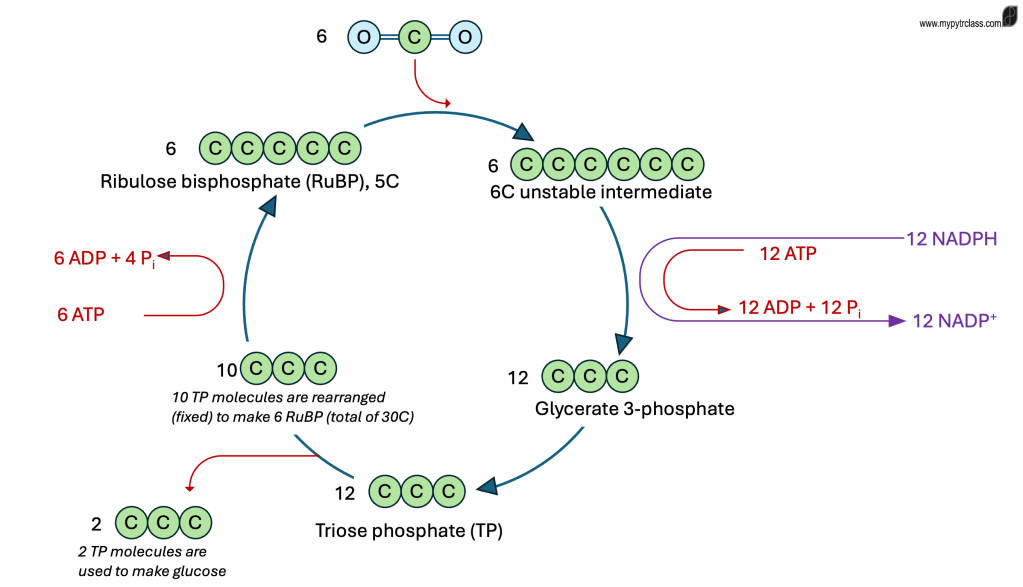
Follow the following steps to describe Calvin cycle:
| Step | Process | What happens |
| 1. Carbon fixation | RuBP + CO₂ | The 5-carbon compound RuBP combines with CO₂. Rubisco (ribulose bisphosphate carboylase an enzyme) catalyses the reaction, forming an unstable 6-carbon compound. |
| 2. Splitting | A single 6C intermediate → 2 glycerate 3-phosphate (GP) molecules | The unstable 6-carbon compound breaks down into two 3-carbon molecules called glycerate 3-phosphate. |
| 3. Reduction | GP → TP | ATP and NADPH from the light-dependent reactions convert glycerate 3-phosphate into triose phosphate (TP). This is a reduction reaction. |
| 4. TP pathways | TP → sugars or RuBP | Some TP leaves the cycle and is used to make sugar phosphates and more complex carbohydrates. Most TP remains in the cycle to regenerate RuBP. |
| 5. Regeneration | TP → RuBP | ATP provides energy to convert the remaining TP molecules back into RuBP, allowing the cycle to continue. 2 additional phosphate groups are needed, hence only 4 Pi are produced when 6 ATPs are used. |
Cyclic and Non-cyclic photophosphorylation
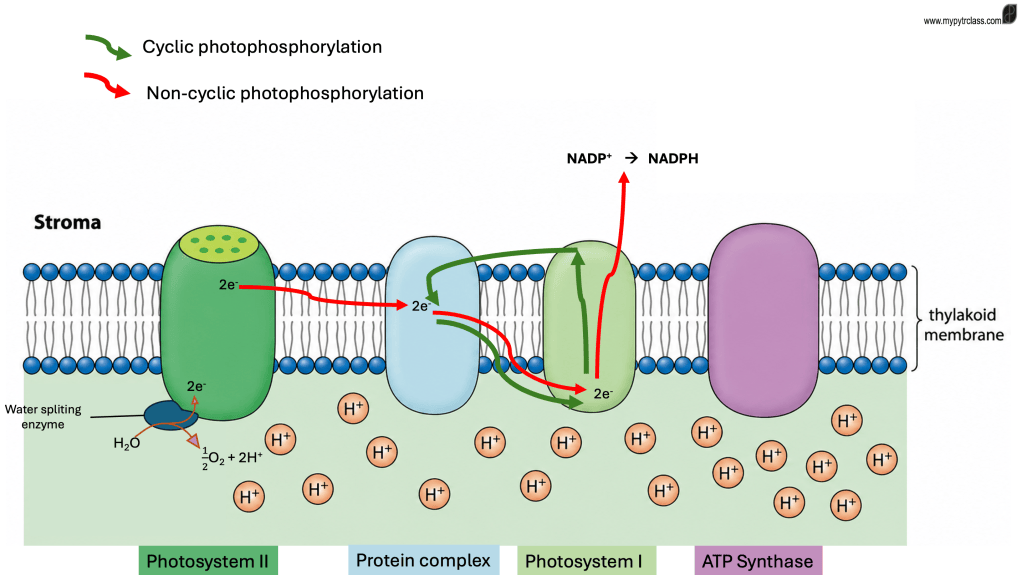
In general, Calvin cycle requires more ATP than NADPH at around 3:2 ratio. A normal light-dependent reaction would produce 1 ATP and 1 NADPH. This means that there must a mechanism to ensure there are more ATP molecules than NADPH. In addition, when CO2 level is low, Calvin cycle slows down. This result in NADPH to accumulate in the stroma. As the result, the light-dependent reaction, specifically the production of ATP, needs to be continued without producing any more NADHP. This mechanism is called cyclic photophosphorylation. In contrast, the non-cyclic photophosphorylation sources electrons by spliting water to produce the ATP and NADPH. The basic comparison between the two is as follow:
| Types: | Non-cyclic photophosphorylation | Cyclic photophosphorylation |
| When it occurs | This is the normal pathway of the light-dependent reactions, where electrons flow from water through Photosystem II (PSII) and electron carriers to Photosystem I (PSI) and ultimately to NADP⁺. | Occurs when reduced NADP⁺ accumulates in the stroma, for example when CO₂ concentration is low and the light-independent reactions are slowed or blocked. |
| Electron source | Electrons are supplied by the photolysis of water at PSII. | Electrons originate from PSI and are recycled back to PSI. |
| Electron flow | Electrons flow in one direction: water → PSII → electron carriers → PSI → NADP⁺. | Electrons are passed from PSI to electron carriers and then returned to PSI, forming a cycle. |
| Proton pumping | As electrons lose energy while passing along the electron carriers, this energy is used to pump H⁺ ions into the thylakoid space. | Electron carriers use the energy of the excited electrons to pump H⁺ ions into the thylakoid space, maintaining the proton gradient. |
| ATP production | The H⁺ gradient drives H⁺ through ATP synthase, producing ATP. | |
| NADPH production | NADPH is produced when electrons from PSI are transferred to NADP⁺. | NADPH is not produced because the electrons return to PSI. |
| Oxygen production | O₂ is produced when water is split during photolysis. | O₂ is not produced |
| Main purpose | Produces ATP and NADPH for use in the light-independent reactions. | Produces additional ATP when the chloroplast requires more ATP relative to NADPH. |
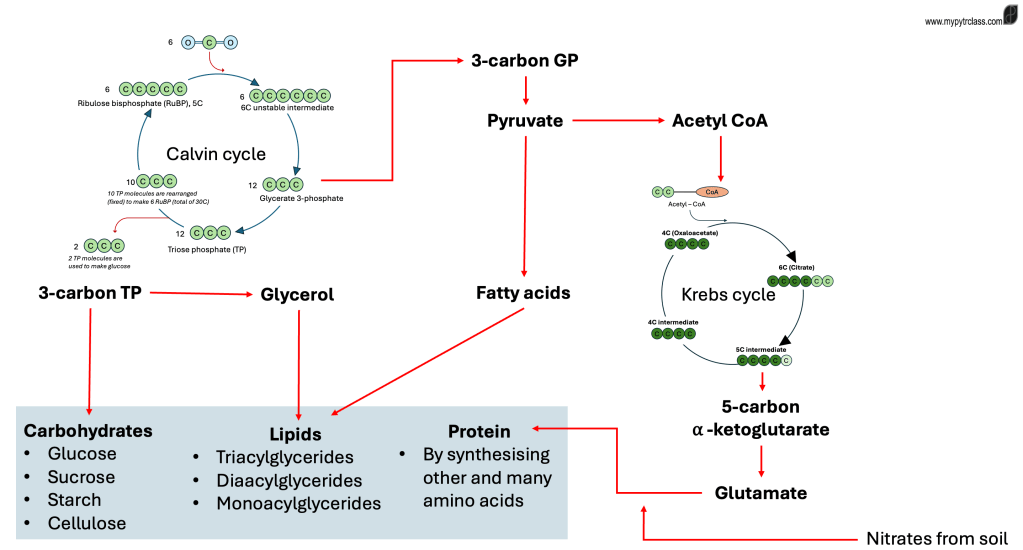
Synthesis of Carbohydrates, Amino Acids and Lipids from 3C molecules
The importance of photosynthesis to green plants is that it produces energy-rich glucose, which provides the carbon and energy needed to synthesize other organic molecules. The plant’s metabolism is therefore largely sustained by the products of photosynthesis. The products of the Calvin cycle, together with mineral nutrients, are used to synthesize carbohydrates, amino acids and other carbon-containing compounds. For example, triose phosphate can be converted into sugars, sugar phosphates and starch, and can also be used to produce lipids, amino acids such as alanine, and organic acids such as malate. This stage is known as the product-synthesis step.
Interdependence of Light-Dependent and Light-Independent Reactions
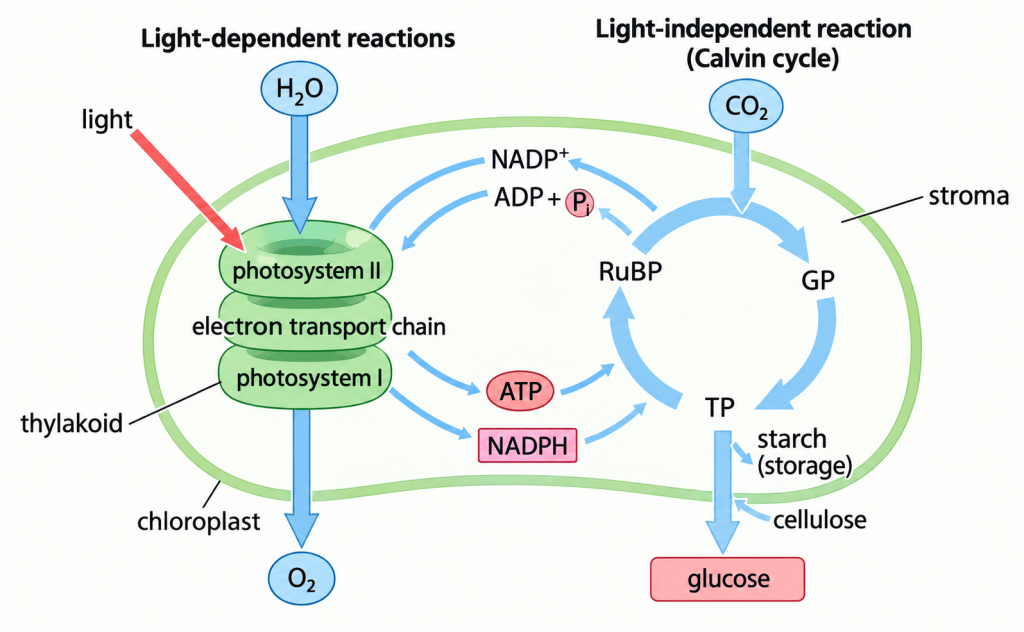
The light-dependent reactions of photosynthesis produce ATP and NADPH, which provide the energy and reducing power required for the light-independent reactions. In the absence of light, ATP and NADPH are no longer produced efficiently, causing the light-independent reactions to slow down or stop. Cyanobacteria, algae and higher plants also require carbon dioxide in solution, particularly as hydrogen carbonate ions (HCO₃⁻), for the optimal functioning of Photosystem II. Hydrogen carbonate has a role in addition to supplying carbon for carbohydrate synthesis because it can accept protons produced during the splitting of water at Photosystem II, helping to support efficient electron transfer. Therefore, carbon dioxide has two important functions in photosynthesis: it ultimately provides the carbon needed to form carbohydrates, while hydrogen carbonate contributes to the functioning of Photosystem II. Removing hydrogen carbonate slows electron transfer through the electron acceptors associated with Photosystem II because hydrogen carbonate is associated with proteins that are important for the electron transport chain. Consequently, a reduction in carbon dioxide and hydrogen carbonate availability not only decreases carbon dioxide fixation but also significantly reduces the activity of Photosystem II.
Exercise
- Distinguish between the light-dependent and light-independent reactions of photosynthesis.
- Distinguish between photolysis and photophosphorylation.
- Explain how the light-independent reactions of photosynthesis depend on the products of the light-dependent reactions.
- Outline the ultimate fate of the electrons displaced from the reaction centre of Photosystem II.


 MyPYTR Class
Leave a comment